
King and Queen Release Dates
Start by naming the date correctly. The Virginia Department of Corrections public documentation uses the label “Release Date.” It does not document a second public field called projected or tentative release date. When that field is in the future on an incarcerated person's record, it is a computation. It can change. An actual release is confirmed later through the status and dated documents, such as an Order of Release or notification-of-release letter.
A King and Queen County defendant held at Middle Peninsula Regional Security Center may be awaiting trial, serving a local term, or held there under VADOC authority. A pretrial detainee has no sentence-based date to calculate. Bond might be granted but not posted. Another case, warrant, or detainer may keep custody active. For a sentenced person, the controlling authority uses the sentence, lawful credits, prior jail time, court orders, and other events to compute the date.
Find King and Queen Release Dates
The right search path follows the custody lane. King and Queen adult local detainees are usually at MPRSC in Saluda, not a county-run jail. State-responsible people can remain in a regional jail for a time and still fall under VADOC authority. That makes a listed location different from the agency that computes the sentence. Federal dates belong to the Bureau of Prisons and should not be read as MPRSC or VADOC dates.
- Decide whether the person is pretrial, serving a local sentence, or serving a VADOC sentence. Use the court case and known booking details.
- For MPRSC custody, check the current inmate listing. Presence shows current listing only; absence does not establish release.
- For state authority, open the VADOC Inmate and Supervisee Locator. Enter the first three letters of the first name and full last name, or the seven-digit DOC ID.
- Use optional location, race, gender, and age-range filters to narrow results, then compare the DOC ID and details.
- Read a displayed Release Date exactly as labeled. If it is future-facing, treat it as computed and subject to change.
- For a local sentence, ask MPRSC for its written credit policy and the person's existing credit ledger. Check the sentencing order with the King and Queen court.
- After the event, obtain the dated release order, letter, or MPRSC release transaction to confirm actual departure and destination.
The King and Queen County released inmates page gives the full records path when a person disappears from the current roster. VADOC updates its locator daily but warns that information can be outdated or inaccurate. A fully discharged person may fall outside its stated current custody and supervision population.
Virginia Credits Shape Release Dates
Virginia has more than one credit framework. VADOC explains that sentence type and date of offense affect the calculation. Jail credit before reception, total sentence, credit class, disciplinary events, and other time-computation events also matter. Consecutive sentences run one after another. Concurrent sentences run at the same time to the extent the court orders. A simple subtraction from the sentence headline can therefore produce the wrong King and Queen County release date.
For felony offenses before January 1, 1995, and certain older misdemeanor sentences, Good Conduct Allowance may apply. VADOC describes class rates from zero through 30 days earned for each 30 days served, with the governing provisions in Virginia Code Title 53.1, including §§ 53.1-198 through 53.1-202. The person’s class and qualifying term control. Do not apply the highest rate to every older sentence.
For felony offenses on or after January 1, 1995, Earned Sentence Credits apply under §§ 53.1-202.2 through 53.1-202.4. Listed ESC-1 offenses can earn from zero through 4.5 days per 30 days. Other qualifying ESC-2 sentences may earn zero, 3.5, 7.5, or 15 days per 30 days, depending on classification and requirements. Credits may be forfeited under § 53.1-189, and restoration depends on law and agency action.
Virginia truth-in-sentencing is often described as requiring service of 85 percent under the traditional post-1994 framework. That shorthand is not universal arithmetic for every current sentence. Enhanced rates can apply to qualifying ESC-2 offenses, while enumerated offenses remain limited. The live offense-specific statute and VADOC computation control.
The official VADOC time-computation page shows the separate credit systems and calculation factors.
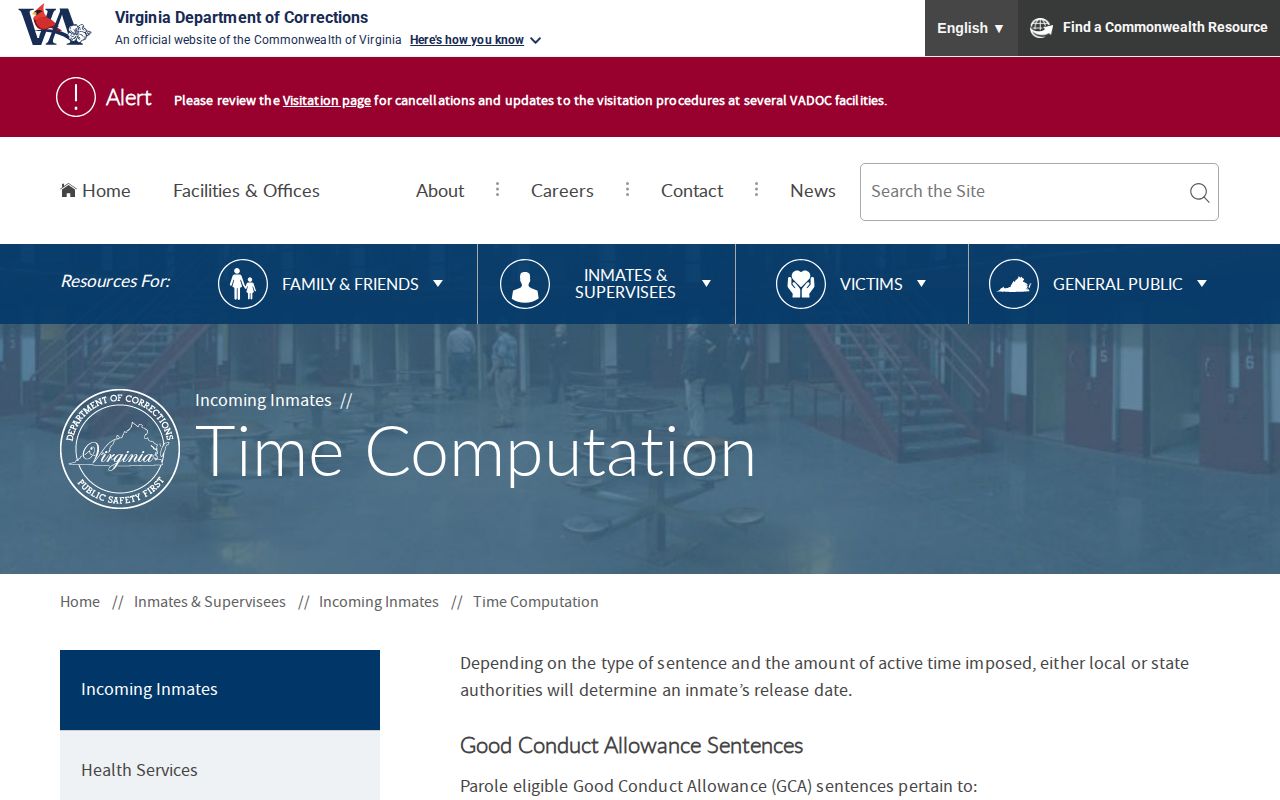
The headings in the official source reinforce why the offense date and credit class must be known before estimating a release date.
King and Queen Local Credits
Local jail time has its own statutory layer. Virginia Code § 53.1-116 requires jailers to maintain an individual prisoner record and a written policy for earned credits and their revocation. For an eligible misdemeanor term of 12 months or less, excluding mandatory-minimum treatment, the statute describes one compliant-day credit per day served and possible added categories. Post-1994 felony credit cannot exceed the Article 4 limits.
For a precise MPRSC date, request the written policy and the individual's existing credit ledger. Ask for records, not a new calculation created for the requester. The sentencing order and jail ledger should be compared because credit for time held before sentence can affect the computation. A local misdemeanant is not placed in the statewide VADOC locator merely by being housed in a Virginia regional jail.
Time-computation questions under state authority go to the VADOC Correspondence Unit and Court & Legal Section, P.O. Box 26963, 6900 Atmore Drive, Richmond, VA 23261. Local MPRSC questions go to the facility at 170 Oakes Landing Road, Saluda, VA 23149, 804-758-2338.
Note: Ask for the existing credit ledger and controlling orders; neither MPRSC nor VADOC must create a custom sentence calculation.
King and Queen Date Changes
A computed date changes when the facts or legal rules behind it change. Some events move the date. Others change only what happens when that date arrives. A detainer, for example, can send a person directly to another agency even if the current facility closes its custody record on schedule.
| Factor | Possible effect | Best record |
|---|---|---|
| Jail credit | Verified time held before VADOC reception can reduce remaining active time. | Commitment papers, court order, and computation record |
| Credit class or conduct | Earned rate, forfeiture, or restoration can move the computed date. | VADOC computation and disciplinary credit record |
| New or corrected court order | A revised sentence, credit award, or clerical correction can alter the calculation. | Signed order and updated computation |
| Concurrent or consecutive terms | The way multiple terms run changes the controlling end date. | Sentencing orders and time computation |
| Parole action | A grant starts release planning; denial or deferral leaves the term in place. | Parole Board report and VADOC release documents |
| Detainer or hold | The date may still end one term while custody continues with another agency. | Detainer and receiving-agency record |
Probation and parole also require careful labels. Probation is court-ordered supervision that may follow confinement or operate instead of it. Parole is release from prison while legal supervision continues. Neither term means full discharge. District 5 Gloucester serves King and Queen for state post-conviction supervision.
King and Queen Weekend Release
MPRSC's weekend-service rules create a distinctive date trap. Under Virginia Code § 53.1-131.1, a court may allow eligible remaining confinement of 45 days or less to be served on weekends or other nonconsecutive days for good cause. MPRSC instructs participants to report at 6 p.m. Friday on each successive weekend. Missing a segment requires court authorization. Failure can lead to a capias, which is a court order for arrest, or conversion to continuous confinement.
Leaving MPRSC after one weekend segment is not final sentence discharge when another reporting date remains. The facility does not publish a universal Sunday exit time. Do not predict one. The controlling court order, MPRSC schedule, and completed-service record show whether a particular departure ends the sentence or only pauses confinement until the next segment.
The official MPRSC weekend confinement instructions show the reporting rule.

This schedule is specific to court-authorized nonconsecutive service and must not be treated as a general release calendar.
King and Queen Court Dates
Court records supply the legal basis for many date changes. The Virginia online case system can show bond actions, dispositions, sentences, and orders for public adult cases. King and Queen General District Court handles misdemeanors and preliminary felony stages. Circuit Court supplies felony trials, sentencing, and final circuit orders. A court record may explain why a person should leave custody, but it does not always state when MPRSC completed the physical release transaction.
Match at least four dates when the record permits: arrest or admission, court disposition or order, computed release, and actual release. A parole decision date is separate, as is the date supervision ends. Circuit Court states that signed orders are mailed to counsel and self-represented parties within five business days. That mailing lag can explain why a recent order is not yet in hand, but it should not be used to estimate the jail-door exit.
Sealed, expunged, juvenile, and otherwise restricted material may not appear in an ordinary public search. Do not rebuild missing details from a stale copy. Ask the court for the accessible order and ask MPRSC or VADOC for the matching custody record. The two sources answer different parts of the question.
Confirm King and Queen Release
The strongest final proof depends on the custodian. For a local term, ask MPRSC for the actual release transaction, including date, time, type, releasing authority, and any transfer destination. For state custody, VADOC identifies the Order of Release, Conditions of Probation, Conditions of Parole, and notification-of-release letter. The release-day documents are read, signed, dated, and witnessed.
A transfer destination changes the meaning of the event. Departure to another jail, VADOC, a psychiatric hospital, ICE, or another custodian is not release to the community. Keep the destination field with the date.
VADOC states that discharge or parole release occurs by 11:59 p.m. on the date, weather permitting. That is a state-facility rule and must not be attributed to MPRSC. The VADOC facility-release source explains the documents and timing.
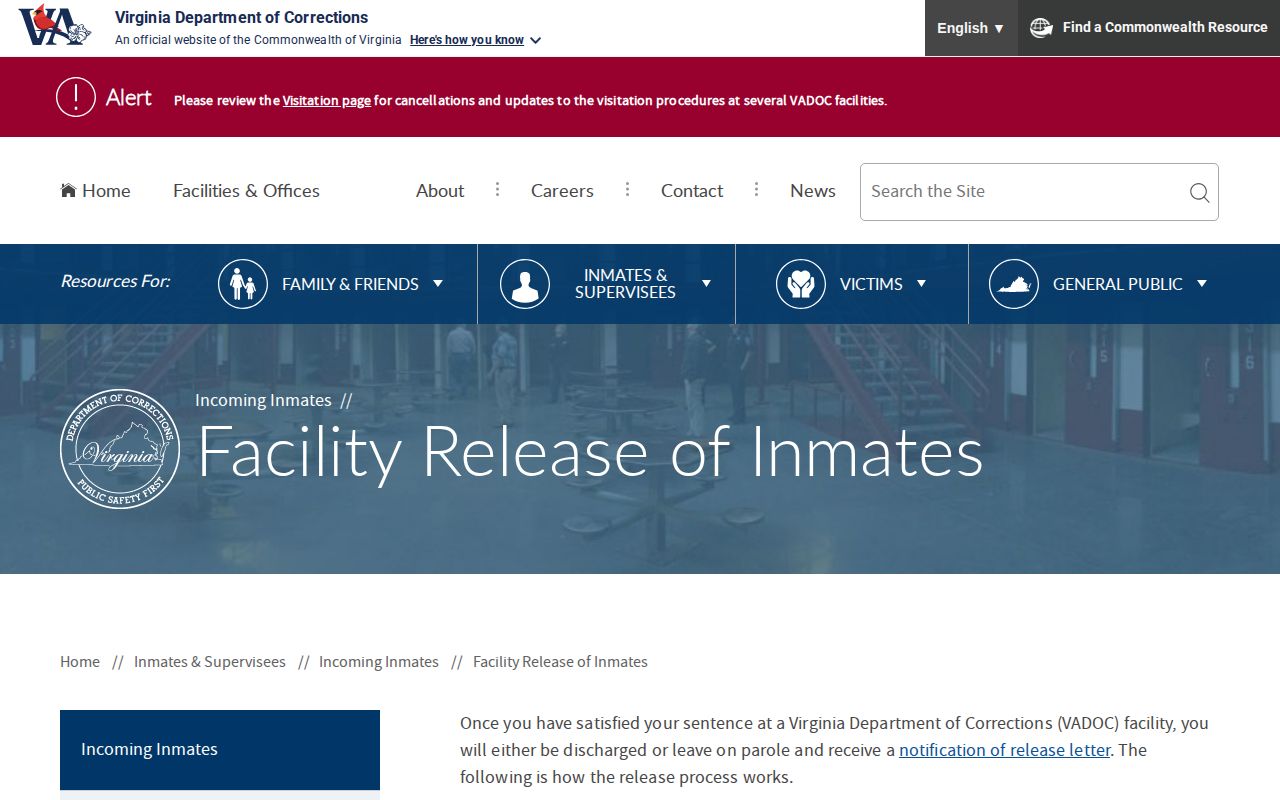
The signed order or letter shows whether the event was discharge, supervised release, or a transfer to another custodian. For a timely local custody alert, the King and Queen County VINELink check can supplement, but not replace, that dated record.